
While you may not have heard the term, the chances that you have come across an outstream video ad while surfing the internet are very high. The first questions that may occur to you are, “What is an outstream video, and why should I care”? Those are both good questions to ask. Let me assure you that, if you are an advertiser or publisher, this is a trend you’ll want to stay on top of. In essence, it can give you a video presence where there appears to be none and an ability to incorporate content that might otherwise be off limits if you don’t have your own video database to pull from. ALL of this, along with the increased effectiveness of video advertising, is sure to improve your numbers.
An instreaming video is an auto-playing video that is inserted into a traditional ad space in an article, where one would typically see a static banner. An outstream ad, also referred to as “in-read” or “native video,” autoplays in a large-format player whenever someone scrolls within the text of an article. The video plays even if the publisher of that article doesn’t have their own video content.
Since outstream almost always lives within text-based content, it’s a form that all publishers can use. It can allow someone without video content to provide ad messaging to their audience, and it also allows those with current video content the opportunity to increase the reach of their ads. These ads can drive viewers back to advertisers’ own content pages that are rich with videos. That can result in a much broader reach of content, which in turn makes ad dollars go a lot further.
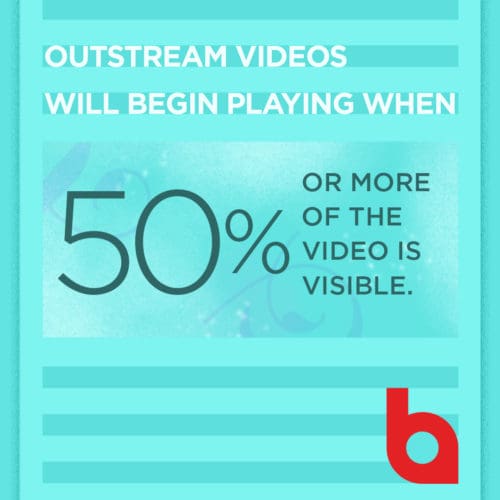
Outstream video is considered to be a very viewable format. These videos begin to play only when they are completely in view, and they stop if the user scrolls to the point where less than 50 percent of the video is visible on their screen. If the user scrolls back to a place where more than 50 percent of the video is visible, it continues to play from the previous stopping point. This helps ensure that your target audience is getting the most out of your message. Although outstream videos are automatically set to play without sound, this can be counteracted by using closed captioning to ensure that the video’s message is getting to the viewer.
To execute on smartphones, vertical video ads should be designed to play in portrait orientation. When these videos are activated by scrolling, they fill the device’s screen without necessitating any special action by the user. This maximizes the impact of the content and helps ensure information is digested.
Capable of helping advertisers no matter the level of their video content, outstream video appears to be a marketer’s best friend. Enabling users to scroll away from content after its initial “splash” onto a viewer’s screen, it has properties that advertisers and consumers alike can appreciate. So when you’re out there on the information highway, maybe reading your favorite blog or an article about how to cook the perfect salmon, be sure to take notice of that autoplaying ad that turns off when you scroll by — and consider how you can use it to spread your marketing message.
By subscribing to our newsletter, you agree to our Privacy Policy.