Get ready for more recent search results and Facebook comments incorporated in your searches, thanks to Google.
Last week, the Internet search company made two announcements on their official blog that will change the way we receive search results. First, on Tuesday, the site announced they would begin indexing comments and posts, including those made on Facebook, within searches.
Two days later, an announcement of a new algorithm that would produce more recent and relevant search results hardly distracted people who were still concerned about the possibility of their Facebook posts appearing in an online search.
But there’s no reason to panic, because this would only apply to public posts, as well as comments made while signed into other websites with Facebook, which are already designated as public. It’s just good to keep in mind that a comment you post on a website, blog or forum, while you are signed into Facebook, could end up in a public search result on Google.
Google explained on their blog that they want searchers to have “the most comprehensive and relevant results,” and they “take precautions to avoid performing any task on a site that could result in executing an unintended user action.”
Keeping this in mind, Google’s new search integration can be a good way for social marketers to see where and who is talking about their clients and brands, and keep a better eye out for spam and inappropriate posts.
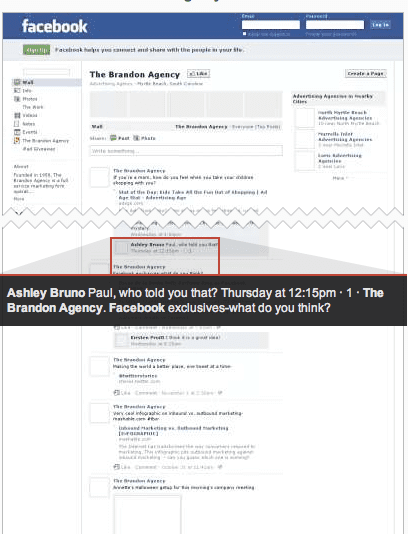
To the right is an example of search results with Facebook comments, showing comments I made on The Brandon Agency’s Facebook page.
Rejuvenated Search Results
With the rollout of Google’s new algorithm, searches are now also smarter, producing more relevant and recent search results.
This was something we expected to happen sooner or later. And with the expectation of instant information these days, it was only logical for the search engines to step it up in order to keep up with social networks like Facebook and Twitter.
This new upgrade, according to Google, will affect 35 percent of searches, showing more pages that are often minutes or even seconds old, in reference to trending topics, regularly occurring events and searches with results that frequently change.
Basically this means when you type something in to Google to search, it will know whether you are looking for results that are only minutes old, versus results that could be years old.
This will definitely be helpful for those of us that are used to breaking news via RSS, text message alerts, or real time updates from Facebook and Twitter. However, I’m not sure how much of a game changer it will be to help break the habit of checking Facebook for the latest breaking stories.
By subscribing to our newsletter, you agree to our Privacy Policy.